Jurassic World: Dominion runs two and a half hours, grossed a billion dollars, and could have been resolved by a mid-level executive with an attachment limit of 25 megabytes.
Four years have passed since the last film. That is the first thing Dominion tells us, and it is worth sitting with, because four years is not nothing. Four years is a school career. Four years is long enough for a court to appoint a guardian, for a government to notice a missing person, for a neighbour to ask a question. Four years is, in most functioning jurisdictions, ample time for somebody to knock on the door of a cabin in the Sierra Nevada and ask the two adults inside where exactly they got the teenager.
Nobody knocks. Nobody has knocked in four years.
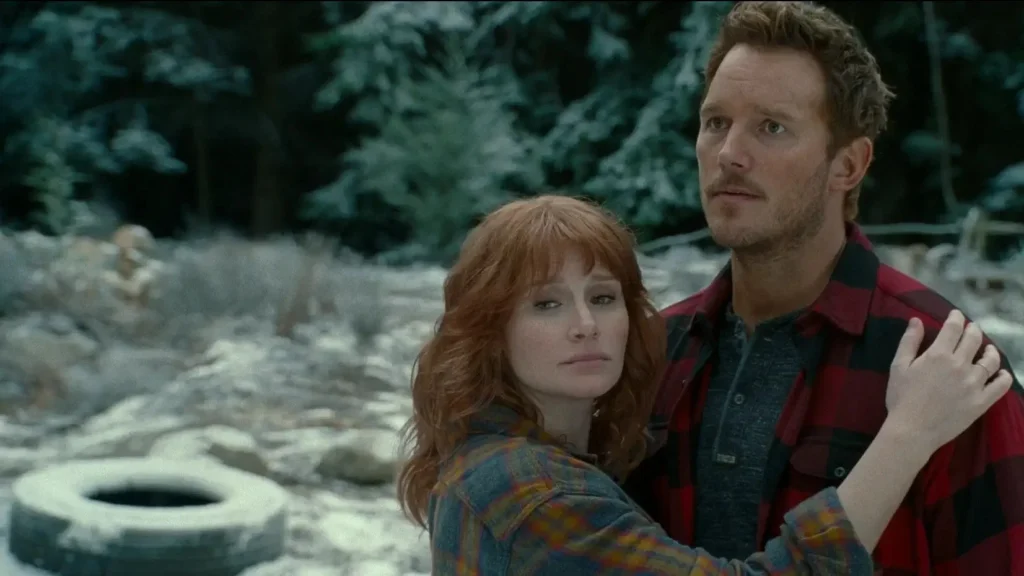
So there are two things to say about this film, and they turn out to be the same thing wearing different hats. The first is that almost nothing anybody does in it is motivated. The second is that its central plot device is a girl who is stolen, stolen again, and then stolen back, and that the film scores the third theft like a homecoming.
Ladies and gentlemen: if you have ever wondered why child protective services needs more funding, I present the case.
Let me be fair to Owen and Claire before I stop being fair to them, because there is one redeeming detail and it deserves its moment. At the end of Fallen Kingdom they asked her. Maisie was given a choice, and she took it, and that is more procedural care than this franchise has extended to any living creature in six films.
Then four years passed, and nobody filed anything.
She is a teenager now, and I want to insist on the word, because it is the engine of everything. Not a child — a teenager. Teenagers are confused, hormonally mutinous, and constitutionally unable to concede that the adults around them might be right about anything. This is not a defect in the species; it is the mechanism by which humans separate from their parents.
Owen and Claire are not her parents. There was no adoption, no hearing, no paperwork, no social worker with a clipboard. There is a cabin in the woods where she does not go to school and does not meet other people, and the film’s position is that this was for her own good, which is also, historically, the position of everyone who has ever done this.
The film walks into a trap here it never notices. Either Maisie exists administratively — in which case there is a file, a custody question, a birth certificate whose absence somebody would have flagged. Or she does not exist administratively — and then we have left the dinosaur genre entirely and arrived somewhere with considerably more basement in it, only with better PR and much better landscape photography.
Dominion declines to answer either way. It simply asks you to find the cabin cosy.
And then BioSyn takes her, and we are meant to be appalled. I was not appalled; I was fascinated. What I was watching was the second abduction, shortly to be followed by a third, which the film would file under rescue. Watch her face in any scene she shares with Owen and Claire: that is not a girl who has been found, that is a girl who is furious and has nowhere to put it. The film reads this as adolescence. I read it as evidence.
And here is the part I did not expect. Over two and a half hours, with the strings section doing what strings sections do, I noticed myself coming round. Warming to the cabin. Rooting for the reunion. That is not a plot; that is a conditioning protocol. The audience develops Stockholm syndrome in real time, alongside the hostage, on a schedule set by the score.
Now to the larger charge, the one that makes the whole thing collapse: nobody in this film has a reason to be where they are, or to do what they do once they get there.
Take Alan Grant. What brings the man to the Dolomites? Not evidence — Ellie has that. Not expertise — nothing about the mission requires a palaeontologist. He comes because he is lonely and because Laura Dern asked, and those are lovely human reasons that are not dramatic ones. His decisive contribution to the resolution of the plot occurs in the amber mines, where he climbs a ladder, discovers a dinosaur waiting at the top, and falls off. I will grant the film this without reservation: that jump scare is beautifully built and it got me, badly, despite my knowing exactly what was coming. One flinch, honestly earned. That is his arc.
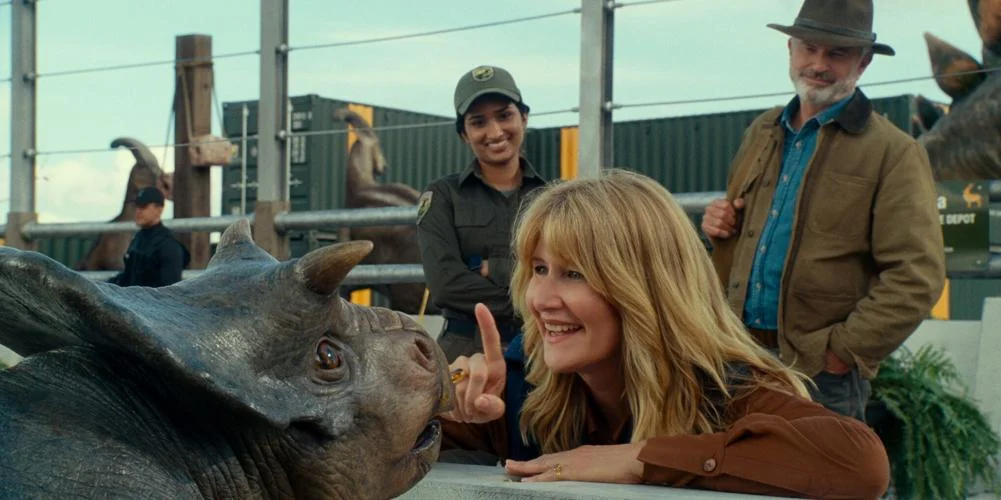
Ellie Sattler starts better, and that is what makes her collapse the more instructive one. She identifies an ecological threat, decides to prove it, and pulls Grant along rather than the reverse. Real motivation, self-generated, arising from her own expertise. And then she arrives at BioSyn and goes looking for — a locust. The same locust. The same DNA she already collected in Texas, in a field, in the first act, with her own hands.
Think about what she is doing. She is a scientist assembling scientific proof for what is not a scientific problem. Nobody disputes that the locusts exist; she has one in a cooler. Producing a second, genetically identical specimen from inside the building proves only that BioSyn also has locusts, which BioSyn would cheerfully concede, because the alibi writes itself and any competent corporate counsel has it in the drawer: Of course we are studying them. They are an acute threat to the global food supply. We would never manufacture them. End of enquiry. Two exhausted regulators go home.
What would actually sink the company is a paper trail. Freight documents. Manifests. Flight movements. Who transported these animals, in whose containers, signed off by whom, billed to which cost centre. That is the ammunition, and it is sitting in a server in the same building she is standing in. Ellie and Alan want scientific proof when what they need is legal proof, and nobody in the film ever says so out loud, because the moment somebody does, the third act evaporates.
And when the Giganotosaurus finally arrives, the woman who drove the entire investigation gets the scream reaction. No decision, no action, no science. Scream, cut, next.
A word about Henry Wu, who has been repainted since we last saw him.
This is a man who made monsters on purpose and enjoyed it. He built the Indominus rex out of ambition and a spreadsheet. He had swagger, spine, the whole Frankenstein register.
None of that energy survives into this film. Wu is soft now, sorrowful, tame as a kitten, and the register B. D. Wong has been directed into is not remorse — it is an unsettling Hannibal Lecter impression, in which he attempts empathy while waiting for the nice Chianti that goes so well with liver and fava beans.
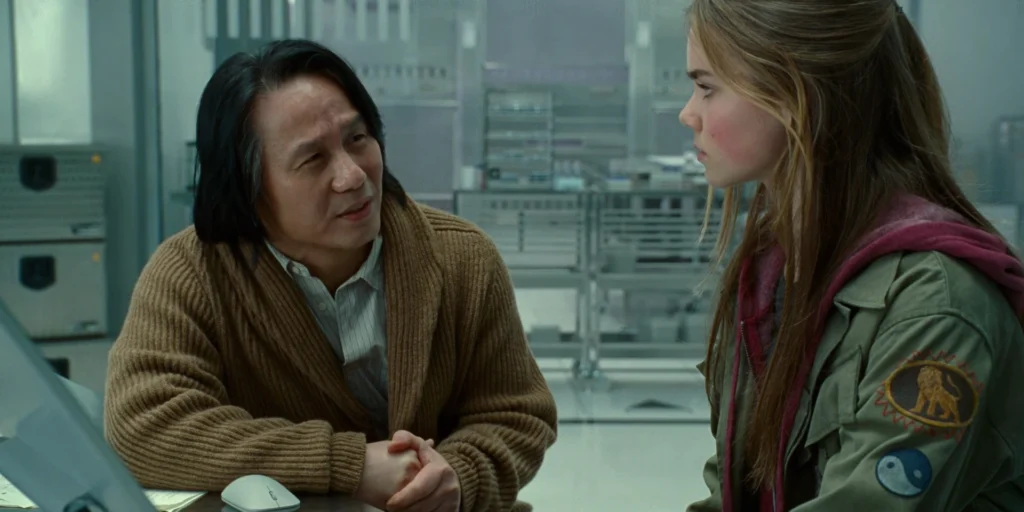
And the softening is not only a performance choice. It is an acquittal. Consider the résumé: the sequences in the first film. The Indominus. The Indoraptor. The locusts. By consequence, by body count, by sheer downstream damage, Henry Wu is the most destructive character this franchise has produced — ahead of Dodgson, ahead of Hammond, ahead of every animal on the payroll. He has never once stood in a room and answered for any of it.
Dominion grants him redemption anyway, off screen, in the gap between two films, for free. He arrives sad, and sadness is accepted as payment.
He does at least concede the crown. Cloning a human being was beyond him, he admits; Charlotte Lockwood managed it alone, and managed it well enough that the result is walking around this film being furious at her guardians. That is the single genuine feat of scientific genius in this universe. It belongs to a woman. She is dead before the opening credits, and she appears only as a face in a flashback montage, explaining the plot to a teenager.
And then Wu fixes the locusts. He is the geneticist, the solution is genetic, he does it. So of the two people who resolve the central crisis of this film, one is BioSyn’s number two and the other is BioSyn’s head of research. Both of them were inside the building the entire time.
Then there is BioSyn itself, which is not motivated either, and this is the one that genuinely astonished me.
Start with the address. The campus sits in a valley in the Dolomites, which is to say: in the Alps, in South Tyrol, in Italy, thirty or forty kilometres from people going about their day. Earlier drafts put it in the Caucasus, and the Caucasus was the better idea, for the obvious reason. I have also never in my life encountered a mountain range that vast without trails on it. Cinema mountains are sheer, unclimbable, hermetically sealed. Real ranges have huts, pasture, waymarking and people in brightly coloured jackets. There is no valley in the Alps where you can keep a secret this size.
The company engineers a locust with a catastrophic appetite and releases it onto the world’s crops — all crops except those grown from BioSyn seed. Fine. That is a scheme. That is, in fact, an excellent scheme, and it has an obvious next step: a two-billion-dollar global advertising campaign for the seed that survives. Trade-press briefings. Ministerial dinners. A very calm man in a very soft grey sweater standing on a stage saying we saw this coming, and we are ready. Immediate market dominance, immediate profit, immediate food security, and the whole thing legal.
None of that exists in this film. The locusts are out there eating the planet and BioSyn’s commercial strategy appears to be waiting quietly in a valley in South Tyrol to see what happens, while burning months of research on an antidote to a plague it created on purpose. The villains committed the crime and forgot to commit the profit.
Unless — and I want to give this its fair hearing — profit was never the point. Perhaps the plan is to decimate humanity outright and hand the planet back to the dinosaurs. Perhaps Dodgson is not Dodgson at all but the Indominus rex, her mind transferred into a human body two films ago, a detail she has neglected to mention to anybody, and the reason we never find out is that the revised script was still printing when two palaeontologists severed the cable with a fire axe.
No. This film is not that clever.
Which means the film’s central threat has no engine behind it, which means everyone chasing it is chasing an intention nobody on screen actually holds.
Structurally, all of this has a cause, and it can be said in one sentence: this is two films, and we only asked for one. Which one? Everyone’s guess is as good as mine.
There is an eco-thriller about an agricultural conglomerate collapsing the global food chain. There is a legacy rescue adventure about a stolen teenager and a stolen raptor hatchling. Both are viable. Neither has anything to do with the other, apart from a shared cast and, eventually, a shared chopper.
At two and a half hours this needed to be far more Men in Black II and far less The Lord of the Rings — and even The Lord of the Rings had the nerve to cut Tom Bombadil, to remove a beloved thing because it did not move. Dominion removes nothing. It brings everything, and because it brings everything, it goes nowhere.
Let me be fair once more, because the film has a virtue I have stopped expecting from blockbusters: it lets you breathe. Scenes are allowed to sit. There are stretches without a cut every 1.4 seconds. Anyone who has recently endured Marty Supreme — a film edited as though by the caffeinated squirrel from Over the Hedge — knows that is not faint praise. Trevorrow can build a space and make an animal look heavy. The visuals work. The set pieces work. The cast works.
Nobody in it has anything to do.
Nowhere is that clearer than with the women, and the precise wording matters. It is not that the film cannot write them; it is that it hands each of them a job that does not touch the plot. Claire ran a dinosaur park; her contribution to the third act is access to the ladies‘ room, for which the film awards her a you clever girl — the most famous line in the franchise, once the moment a man realises raptors think strategically, now applied to a woman who has successfully operated a lavatory door. Ellie gets the axe and the scream. Kayla Watts, the best new character the franchise has produced in a decade, is permitted to fly the helicopter. She flies it well. That is the arc.
Remove any one of them from the causal chain and the story arrives at the same destination, slightly earlier.
Spoilers from here.
Here is the thing that broke the film for me, and I did not see it until the credits.
The central conflict of Jurassic World: Dominion is between Lewis Dodgson and Ramsay Cole. That is the entire load-bearing structure. Cole is the number two of the BioSyn empire — communications chief, inner circle, in every room that matters. He has the access, the documents, the standing, and eventually the conscience.
He does not need Ellie Sattler. He does not need Alan Grant. He does not need Ian Malcolm, who is on the payroll and contributes, across two and a half hours, one keypad joke and a great deal of shirt. Cole does not need a single legacy character to blow the whistle. He needs an outbox.
Attach the manifests. Send to the Department of Justice, the FDA, the New York Times, three MEPs and whoever is currently running the agency that collects escaped dinosaurs. Copy in legal for the paper trail. Done before lunch.
This movie should have been an email. A whistleblowing thriller talked itself into a monster fight because nobody wanted to film a man pressing send.
And once you see it, every act of heroism turns into decoration. Ian Malcolm Zoidberging a Giganotosaurus with a flare — if you know, you know — is not brave, it is unnecessary. Two brilliant scientists granted agency over a fire axe but not over their own minds are not a climax, they are a delay. The film has a whistleblower with full access standing inside the building for the entire running time, and it invents a two-hour rescue operation so the legacy cast has somewhere to stand.
The only other person who genuinely acts is Owen, and I am not sure the film understands what it has given him. He abducts a teenager. He watches a man be tortured by dinosaurs, declining to intervene, in order to extract a name he could almost certainly have obtained another way. And when Henry Wu finally surfaces, on their side, offering help, Owen spends the scene holding a rifle on a geneticist whose only weapon is a ring binder.
Those are decisions. They are the decisions of an antagonist, delivered by a leading man with excellent hair, and nobody on screen ever remarks on them.
Which is a shame, because Owen is likeable. The film simply keeps catching him on his worst days and never notices that it has. In fairness, his dark side is the best-motivated thing in the picture: this is a man who attempted divorce by ejector seat. He ain’t happy, and he ain’t got no way of telling the outside world so, other than by doing something stupid.
Which brings us to the finale, and the question I cannot shake: why is there a three-dinosaur exhibition match?
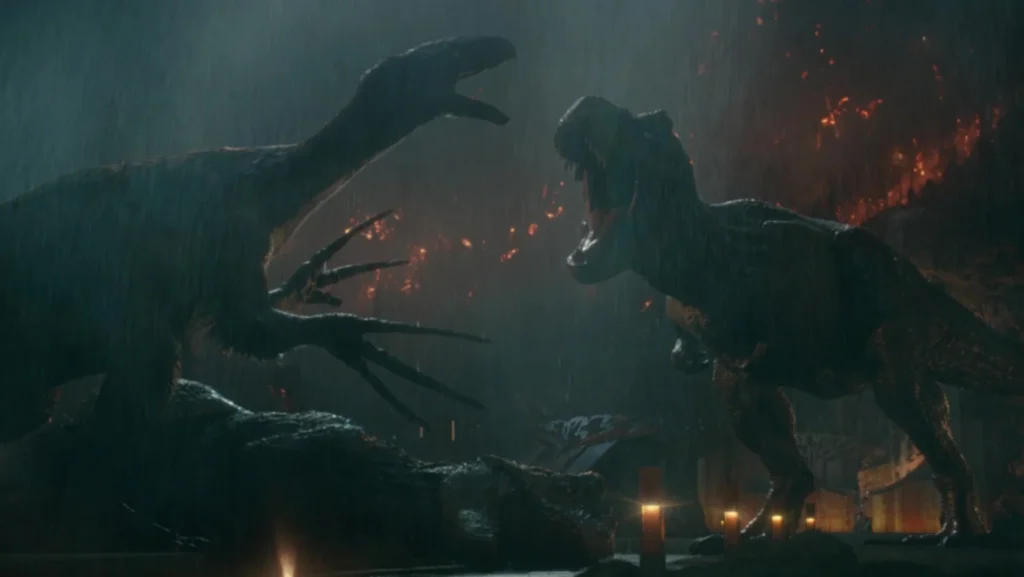
Not a chase. Not a hunt. A match. The Giganotosaurus meets the returning T. rex, and they square off on the forecourt of the BioSyn campus — on the paving, in front of the building, like a scheduled event — while seven human beings, our protagonists, the people whose story this ostensibly is, stand and watch. It takes a while before Sam Neill says this isn’t about us and it occurs to anybody to run. Idiots. Amateurs.
And then the Therizinosaurus — Edward Scissorhands-o-saurus, the enormous armoured herbivore who has spent the film as a beautifully staged environmental hazard — arrives and impales the Giganotosaurus, settling the bout on the T. rex’s behalf. On what basis? These animals share no lineage, no territory, no dispute. A Therizinosaurus is a herbivore. It has no stake in which theropod wins. The scene works only if you accept that the dinosaurs have read the credits and know which one is the returning star.
Note what this does. The climax of a story about people is resolved by three animals whom the people did not influence, while the people watch from the far side of the forecourt.
And the final justice for the bad guy does not sit right with me: he is eaten by the same species that ate Nedry in the first film, which the movie thinks is elegant and I think is cheap. That man does not deserve to be eaten. That man deserves The Hague. A corporation successfully cloned a human being and built a business model on an engineered famine — that is a totally different film, and I would pay to watch it. Jurassic World: Aftermath, a courtroom drama. Manifests entered into evidence. A tired Ian Malcolm on the stand. And Claire and Owen, for abduction.
Instead we get execution by digestive tract, and everyone applauds.
The film does not offer a happy ending; it offers an understanding, which is a very courteous word for we have no solution. Owen carries Beta home himself and hands her back to Blue, and that is clean, and it is earned. It is also the sharpest irony in the film, and an entirely accidental one: the kidnapper personally returns one of his abductees to her parent, and keeps the other.
Maisie finds her way back to the people who took her, and the score swells, and by then I was pleased about it, which is the part that still bothers me.
Half a happy ending, and the wrong half.
Four out of ten. Everything is present — the cast, the craft, the animals, the images, even the air between the scenes. It is simply all assembled wrong: around a threat nobody is monetising, in service of a rescue nobody needed, for a girl nobody ever filed a form about.
And it worked. A billion dollars worldwide on 29 per cent at Rotten Tomatoes and an A− CinemaScore, the third consecutive Jurassic film in the billion club. Critics revolted, tills full. Not an anomaly. The business model.
If you can switch your head off for two and a half hours and want to see how Tim Cook would handle dinosaur logistics, you are welcome here. If you want a good action film, watch the first one.
And if you want the plot, ask Ramsay Cole to forward you the email.
Schreibe einen Kommentar